Visar inlägg med etikett Smutsgam. Visa alla inlägg

tisdag 27 oktober 2015

Lanzarote 3-10/4-15 (my 40th birthday)

Well, to celebrate my 40th birthday, I wanted nothing more than to run away from home and just be with my family. The plan, or rather my wife's plan, was to go to Bornholm... but about a week before this trip, she told me that I could choose, as a birthday gift,  between a new camera house or a longer trip. To the Canary Islands and Lanzarote in particular. The choice was easy. I mean, my camera might be old (bought in 2006) but it still works fine, so I didn't take me five seconds to decide.

Of to Lanzarote and the town Costa Teguise. I had done some homework as to which birds might be possible to see. However, it was never going to be a birding trip but a social trip instead. Though we planned for at least one day with a rental car to see some of the island. Because of the quite cold temperature we actually rented a car twice.

So, as for birding, there were definitely some interesting birds to see. I thought that I should be able to get possibly three new lifers and perhaps as many as five. Well, three I managed but five proved difficult.

First there are some photos from the area surrounding Costa Teguise and then some from other parts, which we reached by car.
Whimbrel (småspov, Numenius phaeopus)
First day after we arrived, we went to the beach to check it out. The beach was really nice and as for birds, this Whimbrel was the only thing that showed itself.
Yellow-legged Gull (medelhavstrut, Larus michahellis 
atlantis)
Another day we rented a four seat bike which took us along the scenery road by the coast. This Yellow-legged Gull, which must be of the atlantic varian (atlantis). This photo might be fooling the eye a little bit but the wings and back does seem quite a lot darker compared to the Yellow-leggs I've seen in Croatia.
Ruddy Turnstone (Roskarl, Arenaria interpres)
During that bike ride, we saw this little group of Turnstones. My wife told med that I couldn't shoot photos of the birds as bathers were close by and they would think I took photos of them...

During this bike ride I also saw a large Tern. Probably a Caspian but I could never get a good enough look at it.
Clouded Yellow Butterfly (rödgul höfjäril, Colias croceus)
On the other side of the town, in towards land, there was a playground for the kids. We went to this playground several times and I brought my binoculars and my camera. I tried to shoot some photos of butterflies as well as I've started to learn butterflies and dragonflies as well. I hope I got the species correct...
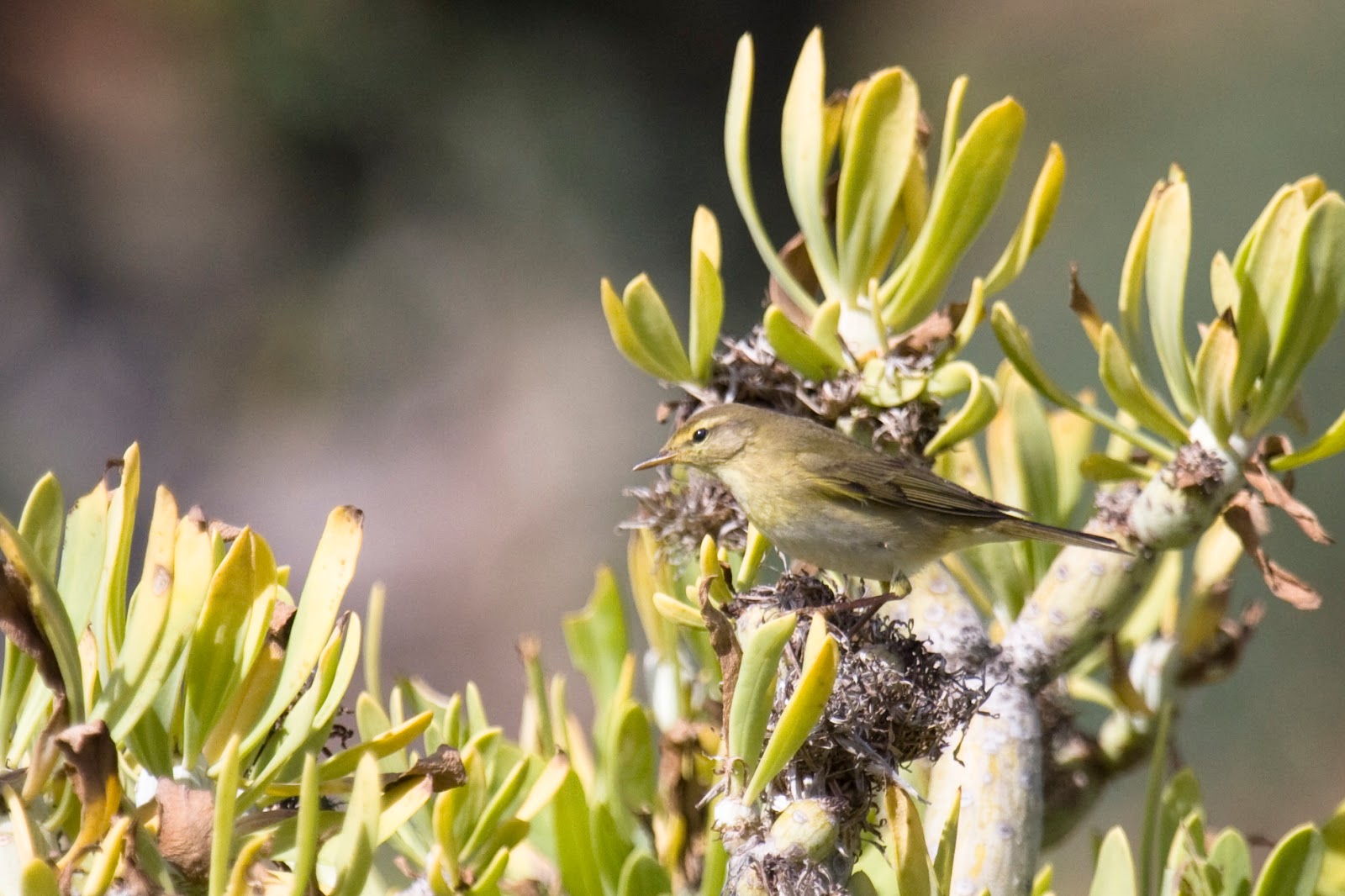
Willow Warbler (lövsångare, Phylloscopus trochilus)
Beside the playground, there were some bushes and som trees and there were actually some birds flying around. This little Phylloscopus warbler was one of them. I really wanted to see an Iberian Chiffchaff or a Canary Islands Chiffchaff but, if I'm not mistaken, this is nothing but a common Willow Warbler...
Willow Warbler (lövsångare, Phylloscopus trochilus)
Swift sp. (seglare, Apus ??)
Now this is where I got a bad feeling after coming home from this trip. I had apparently not done my homework good enough...
This is the only photo I have of this Swift and when I checked my Collin's guide after the trip I realised that there is this Plain Swift in the Canary islands. This could very well have been one but I didn't think to check while still on Lanzarote. Not good...
Spanish Sparrow (spansk sparv, Passer hispaniolensis)
Together with the omnipresent Collared Dove, the Spanish Sparrow was definitely the most common bird.
Southern Grey Shrike (iberisk varfågel, Lanius meridionalis)
Some 50 meters from the playground, mentioned above, I found this beautiful Southern Grey Shrike. As always, Shrikes are alluring to me and I just stood there and watched it for a long time. Turned out to be quite a common bird on Lanzarote, but I didn't mind.
Berthelot's pipit (kanariepiplärka, Anthus berthelotii
One morning I awoke quite early so I could walk about a bit. As soon as you get out of the town and into the lava fields the Berthelot's pipits starts to make themselves heard. Difficult to shoot photos of though... at least the ones I tried to shoot.
Trumpeter Finch (ökentrumpetare, Bucanetes githagineus)
The same morning I saw this Trumpeter Finch. Actually I had already seen one on this trip (photo below) but this was a new lifer for me. During this shart walk I saw at least four Southern Grey Shrikes and at least four Berthelot's pipits.

Other birds close to Costa Teguise were Linnets, Kestrels, House Martins, Feral Doves and one White Wagtail
As I mentioned, during two days we rented a car and drove around the island. We visited the market in the town Teguise (where I saw a Hoopoe) and then drove around the norhern part of the island. First thing after Teguise was to drive over the plain of El Jable. The obvious target species being the Houbara bustard, of course. Well, I wasn't lucky... no bustards could be seen. But plenty of Berthelot's pipits and Lesser Short-toed larks. On the other side of the plain, just by the town of Sóo, I finally saw my first Trumpeter finch. 
Overview of the plain of El Jable from the town Teguise
The scenery on Lanzarote is spectacular almost everywhere. Old volcanos can be seen in many places. You are seldom out of view of one.

The plain between Teguise (from where this photo is shot) and the town on the other side is supposed to be one of the best places for the Houbara bustard
Tja
Hoopoe (härfågel, Upupa epops)
After crossing El Jable, we closed in on Sóo and stopped at a some stone walls, close to some vegetable patches, where this Hoopoe was feeding.
Tja
Trumpeter Finch (ökentrumpetare, Bucanetes githagineus)
My first ever Trumpeter Finch. Not in the nice, male plumage but still...
Tja
Lesser Short-toed Lark (korttålärka, Calandrella rufescens)
The Lesser Short-toed Lark is easy to find on the El Jable plain.
Tja
Egyptian Vulture (Smutsgam, Neophron percnopterus)
As we didn't see the Houbara bustard, this Egyptian vulture was a little bit of consolation :-)
After the El Jable plain, we drove to the lookout point of Mirador del Rio. I got my first really good view of a Berthelots't pipit here but didn't manage to take a photo of it.
Painted Lady (tistelfjäril, Vanessa cardui)
At Mirador del Rio, I saw this nice butterfly.
On my 40th birthday, I drove again to El Jable plain. I didn't want to give up on the Houbara bustard so we rented a car the evenening before so I could get out early in the morning. 
Berthelot's pipit (kanariepiplärka, Anthus berthelotii
As mentioned before, the Berthelot's pipit is common on the plain and this time I managed to get some photos.
Tja
Berthelot's pipit (kanariepiplärka, Anthus berthelotii

Tja
Houbara Bustard (ökentrapp, Chlamydotis undulata)
Finally!! There it was. In the morning sun. The Houbara bustard. The third lifer for me on this trip.
Tja

Cream-colored Courser (ökenlöpare, Cursorius cursor)
When I drove on after the Houbara, I saw a flying bird which resembled a large shore bird. I drove down a side road to see if I could find it. I had a notion in my mind that it could be a Cream-colored Courser and when I found the bird again I was proven to be right.

I've seen the Cream-colored Courser before, in Dubai, but never as close as here.
Tja
Cream-colored Courser (ökenlöpare, Cursorius cursor)
When I got out of the car to shoot some photos of the group of Coursers - there were at least 7 individuals - I more or less stumbled upon this one. I shot some quick photos before receding, in order to not disturb the bird more.
Tja
Cream-colored Courser (ökenlöpare, Cursorius cursor)
Some of the birds in the group.
Tja
The dramatic view of the west coast of Lanzarote. Beautiful!
Lanzarote is definitely not only for birding, you can do that without spending a hole week. The scenery is, as mentioned befor, spectacular.
Hej
We visitid the national park of Timanfaya, where the latest volcanic activity was recorded. Very interesting and beautiful in its own way. Is definitely worth a visist, even though there are many tourists here. There is also a restaurant here where you can eat volcano barbecue. Meat and vegetables grilled over volcanic heat.
Other birding spots which should be mentioned would include the Salinas de Janubio. We stopped very shortly beside the salinas but I soon realised that a spotting scope would be of great use here. I did see a family of Ruddy Shelducks but nothing more during my short stay. 

List of birds seen on Lanzarote:
Berthelot's pipit (kanariepiplärka, Anthus berthelotii)
Spanish Sparrow (spansk sparv, Passer hispaniolensis)
Collared Dove (turkduva, Streptopelia decaocto)
Whimbrel (småspov, Numenius phaeopus)
White Wagtail (sädesärla, Motacilla alba)
Kestrel (tornfalk, Falco tinnunculus)
Southern Grey Shrike (iberisk varfågel, Lanius meridionalis)
Linnet (hämpling, Linaria cannabina)
Swift sp. (seglare, Apus ??)
House Martin (hussvala, Delichon urbicum)
Willow Warbler (lövsångare, Phylloscopus trochilus)
Cattle Egret (kohäger, Bubulcus ibis)
Hoopoe (härfågel, Upupa epops)
Lesser Short-toed Lark (korttålärka, Calandrella rufescens)
Southern Grey Shrike (iberisk varfågel, Lanius meridionalis)
Egyptian Vulture (Smutsgam, Neophron percnopterus)
Trumpeter Finch (ökentrumpetare, Bucanetes githagineus)
Yellow-legged Gull (medelhavstrut, Larus michahellis atlantis)
White Stork (vit stork, Ciconia ciconia)
Ruddy Turnstone (Roskarl, Arenaria interpres)
Houbara Bustard (ökentrapp, Chlamydotis undulata)
Cream-colored Courser (ökenlöpare, Cursorius cursor)
Ruddy Shelduck (Rostand, Tadorna ferruginea)
Clouded Yellow Butterfly (rödgul höfjäril, Colias croceus)
Painted Lady (tistelfjäril, Vanessa cardui)

lördag 25 juli 2015

1/11-15 Green Mubazzarah and Jebel Hafit

Day two of my birding excursions with Mark started in the same way as day one. We met at 04:30 in the morning. I'll be completely honest and say that I was very tired this morning. A long day, the day before and then an evening with my family and a pretty late night, was perhaps a little bit too much for me... But on the other hand I was really looking forward to the sites we were supposed to visit.

First off would be the Green Mubazzarah, a man made park in the middle of the desert and at the foot of Jebel Hafit. After that we would go up the mountain (Jebel Hafit), we would visit Zakher lake and Al Qua'a fodder field. I had, in advance, read what I could about these places, in order to be prepared for this day. Especially Al Qua'a fodder field held some special allure to me. Last year when I visited UAE there had been two Amur Falcons in Al Qua'a, a species I would very much like to see. There were none reported before this trip so I didn't really hope too much...

Anyway, we started off towards Green Mubazzarah. A coffe on the road made life a little easier and soon we could the the first traces of the morning in the sky. We approached the site when the sun was just up and the green park with its manufacured little stream made a nice contrast to the desert. At least in the beginning but then, again, the amount of litter started bothering me. I can't believe that they don't take care of their nature better.

Some birds were present on the turf; Wagtails and Pipits. We drove around one of the places where the Hooded Wheatear (munkstenskvätta, Oenanthe monacha), one of the target species for this trip, could often be seen. Mark told me that he was bad luck when it came to Hooded Wheatear and, to be sure, no specimens could be seen. 

We parked the car and started down the little wadi, just by the park. Another of the target species for today was the Sand Partrigde (ökenhöna, Ammoperdix heyi), which with some luck should be present here. We were lucky... Mark immediately spotted a siluette up on the stony ridge of the wadi. Very nice. A couple of Blue Rock-Thrush (blåtrast, Monticola solitarius) were also there and it also turned out to be a good place for Arabian Babbler (arabskriktrast, Turdoides squamiceps).

Sand Partridge (ökenhöna, Ammoperdix heyi)
Up on the ridge, one Sand Partridge could be seen. Much better in the scope of course but this made for a nice start of the morning, despite me being very tired. A new lifer.

Arabian Babbler (arabskriktrast, Turdoides squamiceps)
Still exotic for me but not very rare in UAE. But in order to see the Arabian Babbler you need to get out of the Dubai city center, for sure. Though I believe that some of the parks and perhaps the Pivot fields can hold some Babblers.
We started walking up the Wadi and some of the species we had amed for yesterday in Masafi Wadi were present here as well. Several Plain Leaf-Warblers (dvärgsångare, Phylloscopus neglectus) could be seen and finally we got to see the Desert Whitethroat (ökenärtsångare, Sylvia minula), which we only heard, the day before. In the upper end of the Wadi, there was another male Black Redstart (svart rödstjärt, Phoenicurus ochruros) probably of race phoenicuroides. More Desert Whitethroats everywhere and also Plain Leaf Warblers. 

Plain Leaf-Warbler (dvärgsångare, Phylloscopus neglectus)
It was nice to see some more Plain Leaf Warblers and this time they were easier to get close (or at least closer..) to. But the light was still pretty poor, the Wadi being in the shadow of Jebel Hafit.
Desert Whitethroat (ökenärtsångare, Sylvia minula)
Finally here it was, the Desert Whitethroat. I had to spend some time to manage this shot of one of the birds...

In the blog post from Masafi Wadi I called them Desert Lesser Whitethroat, which is the name for the bird in the "Birds of the UAE" but in the official list of Swedish bird names it is called Desert Whitethroat, which I why I used that name here.
Desert Whitethroat (ökenärtsångare, Sylvia minula)
We headed down the Wadi to what had once been a dam, I think. nothing new while walking there but on the way back we got some better views of Sand Partridges and I took some time to try to take some decent photos of Hume's and Red-Tailed Wheatears. 

Sand Partridge (ökenhöna, Ammoperdix heyi)
The Sand Partridges were not very accomodating when it came to photography... This was the best shot I got but at least it shows what I believe to be a typical environment of where they live.
Red-tailed Wheatear (persisk stenskvätta, Oenanthe chrysopygia)
Hume's Wheatear (svartvit stenskvätta, Oenanthe alboniger)
After walking through the Wadi, we drove a short distance to the artificial stream going through the park. We were looking for, among other things, Crakes of different kinds, but found none. We saw two Arabian Partridges (arabisk rödhöna, Alectoris melanocephala), but as they are a known to be introduces, the find was not that cool. I hope I get to see them during my trip to Oman in November.

Hoopoe (härfågel, Upupa epops)
The everpresent Hoopoe, beautiful as always.
After the Green Mubazzarah we drove towards Jebel Hafit. At this point I was really, really tired and started thinking how I would get through the day without sleeping some... As always, though, the mountains are beautiful and Jebel Hafit was no exception.

We stopped at the Mercure hotel, another place where there was a good chance of finding the Hooded Wheatear (munkstenskvätta, Oenanthe monacha). After not finding it in the parking zone, where it is quite often found, we started walking around the hotel itself. Still tired, but I pushed on as this was one of the absolute top species I wanted to see during these two days. 

First we found a couple of White-spectacled Bulbul (levantbulbyl, Pycnonotus xanthopygos) but still the Wheatear eluded us. We walked around the pool, where a Black Redstart was seen, and up to the lookout spot. There it was!! At a little bit of a distance sitting on a light fitting below the lookout spot. Perfect!!

Hooded Wheatear (munkstenskvätta, Oenanthe monacha)

Hooded Wheatear (munkstenskvätta, Oenanthe monacha)
The Hooded Wheatear, a 1cy male, showed itself nicely from the lookout point for some time until it flew off.
We studied the Wheatear for some time until it flew off. As Mark had relatively few encounters of this species he was also pretty happy. I definitely thought we had seen the last of this bird but instead of flying away it flew towards us. As it happens, it flew all the way to the wall, which we were leaning against. It stopped just two meeters away... Close enough that I didn't get the hole bird in my shot below, the feet are missing. I then stayed close to us for a long time and the photos below are just a selection of all the shots I got. Another Black Redstart kept the Wheatear company in the hotel yard where I spent some time taking photos.

Hooded Wheatear (munkstenskvätta, Oenanthe monacha)

Hooded Wheatear (munkstenskvätta, Oenanthe monacha)

Hooded Wheatear (munkstenskvätta, Oenanthe monacha)

Hooded Wheatear (munkstenskvätta, Oenanthe monacha)

Hooded Wheatear (munkstenskvätta, Oenanthe monacha)
Nice close up of a nice bird!
Black Redstart (svart rödstjärt, Phoenicurus ochruros)
After the hotel, we drove further up the mountain towards the main vantage point. On the way we stopped for a while in another good spot. There were supposed to be Egyptian Vultures (smutsgam, Neophron percnopterus) on the mountain and normally you shoul be able to see several sitting in a mast on the mountain but none could be seen this day. Mark found one pretty far off, which was very nice. It dissapeared behing a small mountain knob and I figured that that was it. But it came back, flying just over our heads giving us a spectacular view of the bird. 

We saw one more in the distance a little bit later on but this was the last bit in Jebel Hafit and after this we drove off towards Zakher lake, but more about that in another blog post.
Egyptian Vulture (smutsgam, Neophron percnopterus)

Egyptian Vulture (smutsgam, Neophron percnopterus)

New species in Green Mubazzarah and Jebel Hafit were: Egyptian Vulture (smutsgam, Neophron percnopterus), Sand Partridge (ökenhöna, Ammoperdix heyi), Desert Whitethroat (ökenärtsångare, Sylvia minula) and Hooded Wheatear (munkstenskvätta, Oenanthe monacha)

Other nice birds consisted of e.g.: Indian Roller (indisk blåkråka, Coracias benghalensis), Hoopoe (härfågel, Upupa epops), Desert Lark (stenökenlärka, Ammomanes deserti), Sand Martin (backsvala, Riparia riparia), Pale Crag-Martin (blek klippsvala, Hirundo obsoleta), White Wagtail (sädesärla, Motacilla alba), Red-vented Bulbul (rödgumpad bulbyl, Pycnonotus cafer), Isabelline Wheatear (isabellastenskvätta, Oenanthe isabellina)