Visar inlägg med etikett UAE. Visa alla inlägg

fredag 16 oktober 2015

1/11-14 Al Qua'a fodder field

Ok, it's been almost a year since I visited this place so it's about time I finish these blog posts about my days with Mark, birding in UAE in October/November -14. I'm soon off to a new birding trip, 10 days in Oman in the second half of November so more travel blog posts are to be expected. Though perhaps not quite as detailed as these ones have been.

Last major stop during my two days with Mark was the Al Qua'a fodder field. A place which I had looked forward to very much since my visit in UAE in 2013. At that time, there had been two Amur Falcons (amurfalk, Falco amurensis) at the fodder field and Crested Honey Buzzard (tofsbivråk, Pernis ptilorhynchus) I believe is a regular species found here.

This time though, there were neither Amur Falcons nor Honey Buzzards over the fields. Quite a few Kestrels (tornfalk, Falco tinnunculus), a Marsh Harrier (brun kärrhök, Circus aeruginosus) and some Western Cattle Egrets (kohäger, Bubulcus ibis) together with a lot of Tawny Pipits (fältpiplärka, Anthus campestris), a few Desert Wheatears (ökenstenskvätta, Oenanthe deserti) and Daurian Shrikes (isabellatörnskata, Lanius isabellinus) were the most obvious species around. We also found a Stonechat (svarthakad buskskvätta, Saxicola rubicola) and at least one Richard's Pipit (större piplärka, Anthus richardi) but what finally caught our attention was the Montague's/Pallid harrier (ängs/stäpphök) which showed itself from afar. After some studying some poor photos of the bird we could finally say that it was a Pallid Harrier (stäpphök, Circus macrourus), which was a new species for me.

Daurian Shrike (isabellatörnskata, Lanius isabellinus)
This Daurian Shrike should be viewed together with the Turkestan shrikes in the post from Dubai Pivot fields. The differences between the species (for 1cy birds) can be seen when compared.
Daurian Shrike (isabellatörnskata, Lanius isabellinus)
Marsh Harrier (brun kärrhök, Circus aeruginosus)
It took some time to get good enough photos to be able to identify this bird as a Pallid Harrier. But, then again, it was my first and it is not that easy to tell from Montague's...
The last thing we did before leavin Al Qua'a was to free this little Quail. We saw a man placing this trap (raptor trap) some distance away from us and Mark wanted to see if we could find it and I didn't mind, to say the least. This time, there was no raptor trapped but I guess they capture quite a few... even though it's supposted to be illegal. The trap itself was also destroyed. Not a very nice finish to this place.

Where this trap was placed we also spotted a Short-toed Lark (korttålärka, Calandrella brachydactyla)
Captured Quail (Uppfödd vaktel)
On the way back to Al Ain, a Brown-necked Raven (ökenkorp, Corvus ruficollis) flew over the road. A new species for this trip.

While driving back towards the west coast, it the sun set. Now, this was the plan all along as we were aiming for the Al Wathba Camel Race track. The obvious target species being the Egyptian Nightjar (ökennattskärra, Caprimulgus aegyptius). With the help of playing the call of the Nightjar and a quite powerful lamp, we managed to get a good view of the bird. A perfect ending to a very nice day and two excelent birding days, which I will always remember. Thanks Mark!!

New species during this part were the Pallid harrier and the Egyptian Nightjar.

In the end, I could count to some 25 new species during these two days and a lot of laughs on top of that. :-)

1/11-14 Zakher lake

This peculiar lake, in the middle of the desert (and I literally mean the middle of the desert, large dunes close by), is a fantastic birding spot. Of course, water in UAE draws wildlife like bees to honey and there were a lot of birds in this large lake. Due to its size, its a bit difficult to completely cover the entire lake but still, a lot could be seen. 

We first drove on a sandy road betweed a couple of dunes to reach one side of the lake. We stopped to check the lake but from this side, the distances were to big for any photos to be taken and we didn't really see anythin worth mentioning except for, perhaps, the trip's only Greater Flamingo (större flamingo, Phoenicopterus ruber).

We drove around the lake to a spotting place just beside the road. From here we could see a lot of waders and other birds close by.
Glossy Ibis (bronsibis, Plegadis falcinellus)
First nice bird from the second stop by the Zakher lake was this Glossy Ibis (bronsibis, Plegadis falcinellus)
Soon Mark got excited... He had found a Jack Snipe (dvärgbeckasin, Lymnocryptes minimus). We drove closer to try to get some photos. So, I started shooting photos. In the end we managed to get really close to the Snipe, which was not at all bothered by us.
Red-wattled Lapwing (rödflikvipa, Vanellus indicus)
Snipe (enkelbeckasin, Gallinago gallinago)
First photo of the Snipe... At first I just started to shoot photos. Then I realised that something was wrong...
Red-wattled Lapwing (rödflikvipa, Vanellus indicus)
Snipe (enkelbeckasin, Gallinago gallinago)
It turned out to be a Common Snipe (enkelbeckasin, Gallinago gallinago)... But Mark was, of course, not wrong in seeing a Jack Snipe. It was just a little bit to the right and quite a bit smaller.
This was the first time for me seeing a Jack Snipe like this. If I remember correctly, I have once in my youth heard a Jack Snipe during a visit to Store mosse in Småland (Sweden) but that might be a false memory...
Jack Snipe (dvärgbeckasin, Lymnocryptes minimus)
Here it is, the Jack Snipe. There will be quite a few photos now picturing this bird.
Jack Snipe (dvärgbeckasin, Lymnocryptes minimus)
As with so many places in UAE, there is trash everywhere. Really sad to see...
Jack Snipe (dvärgbeckasin, Lymnocryptes minimus)
Other birds were of course present.
Little Stint (småsnäppa, Calidris minuta)
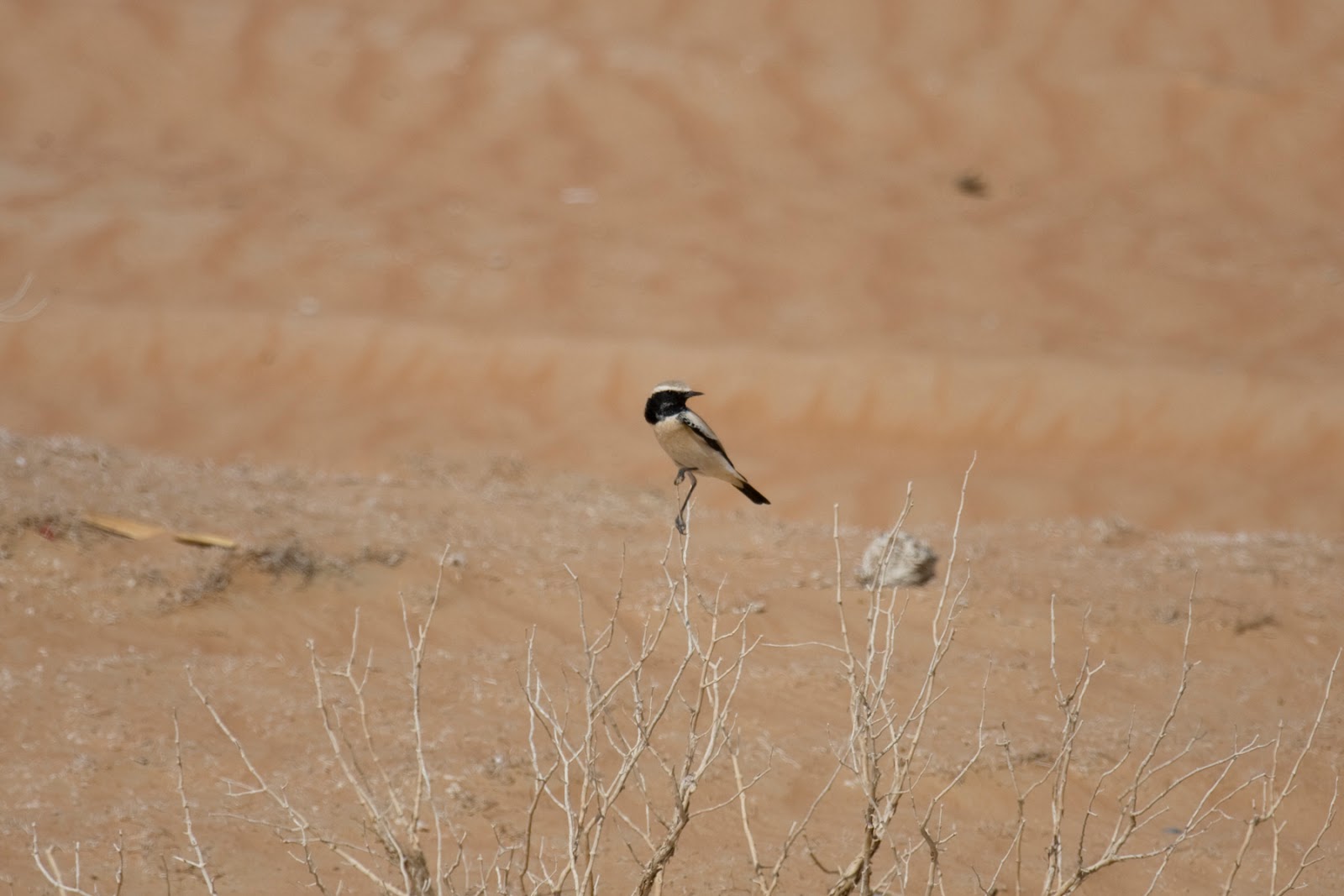
Just beside the lake, the desert is everywhere. And also the deser birds. The red dunes can be seen behind this nice male Desert Wheatear (ökenstenskvätta, Oenanthe deserti). 
Desert Wheatear (ökenstenskvätta, Oenanthe deserti)
Immediately on the other side of the road, still close to the lake, we went looking for another elusive bird. I did not manage to see it during my previous trip to UEA but this time I was luckier. It didn't take five minutes before no less than three Asian Desert Warbler (ökensångare, Sylvia nana) could be found. 
Asian Desert Warbler (ökensångare, Sylvia nana)
Not a good photo but the Deser Warbler tried to stay as far away from me as possible...
Before driving down to Al Qua'a fodder field, which was the last main stop during this trip, we visited one of the parks in Al Ain called Al Jimi Oasis, where we hoped to find a Pallid Scops Owl (blek dvärguv, Otus brucei). Now, Mark knew which tree the owl was supposed to roost in so we went to the tree and started looking. No owl... We checked all the other trees close by but no owl. I must have checked the same tree at least ten times beford Mark suddenly said that he had found it. In the same tree as we had checked so many times. But there it was and I cannot understand how we managed to miss it. 
What a beauty though...
Pallid Scops Owl (blek dvärguv, Otus brucei)
So, new species for me here at Zakher lake and Al Jimi oasis were Asian Deser Lark and Pallid Scops Owl. Below there is a list of some of the birds seen in these two locations

Little Grebe (smådopping, Tachybaptus ruficollis)
Glossy Ibis (bronsibis, Plegadis falcinellus)
Cormorant (storskarv, Phalacrocorax carbo)
Grey Heron (gråhäger, Ardea cinerea)
Greater Flamingo (större flamingo, Phoenicopterus ruber)
Egyptian Goose (nilgås, Alopochen aegyptiacus)
Shoveler (skedand, Anas clypeata)
Garganey (årta, Anas querquedula)
Pochard (brunand, Aythya ferina)
Marsh Harrier (brun kärrhök, Circus aeruginosus)
Coot (sothöna, Fulica atra)
Black-winged Stilt (styltlöpare, Himantopus himantopus)
Ringed Plover (större strandpipare, Charadrius hiaticula)
Kentish Plover (svartbent strandpipare, Charadrius alexandrinus)
Red-wattled Lapwing (rödflikvipa, Vanellus indicus)
White-tailed Lapwing (sumpvipa, Vanellus leucurus)
Snipe (enkelbeckasin, Gallinago gallinago)
Jack Snipe (dvärgbeckasin, Lymnocryptes minimus)
Little Stint (småsnäppa, Calidris minuta)
Temminck's Stint (mosnäppa, Calidris temminckii)
Lesser Black-backed Gull (silltrut, Larus fuscus heuglini)
Caspian Gull (kaspisk trut, Larus cachinnans barabensis)
White-winged Tern (vitvingad tärna, Chlidonias leucopterus)
Sand Martin (backsvala, Riparia riparia)
Pale Crag-Martin (blek klippseglare, Hirundo obsoleta)
Citrine Wagtail (citronärla, Motacilla citreola)
Desert Wheatear (ökenstenskvätta, Oenanthe deserti)
Asian Desert Warbler (ökensångare, Sylvia nana)
Pallid Scops Owl (blek dvärguv, Otus brucei)

lördag 25 juli 2015

1/11-15 Green Mubazzarah and Jebel Hafit

Day two of my birding excursions with Mark started in the same way as day one. We met at 04:30 in the morning. I'll be completely honest and say that I was very tired this morning. A long day, the day before and then an evening with my family and a pretty late night, was perhaps a little bit too much for me... But on the other hand I was really looking forward to the sites we were supposed to visit.

First off would be the Green Mubazzarah, a man made park in the middle of the desert and at the foot of Jebel Hafit. After that we would go up the mountain (Jebel Hafit), we would visit Zakher lake and Al Qua'a fodder field. I had, in advance, read what I could about these places, in order to be prepared for this day. Especially Al Qua'a fodder field held some special allure to me. Last year when I visited UAE there had been two Amur Falcons in Al Qua'a, a species I would very much like to see. There were none reported before this trip so I didn't really hope too much...

Anyway, we started off towards Green Mubazzarah. A coffe on the road made life a little easier and soon we could the the first traces of the morning in the sky. We approached the site when the sun was just up and the green park with its manufacured little stream made a nice contrast to the desert. At least in the beginning but then, again, the amount of litter started bothering me. I can't believe that they don't take care of their nature better.

Some birds were present on the turf; Wagtails and Pipits. We drove around one of the places where the Hooded Wheatear (munkstenskvätta, Oenanthe monacha), one of the target species for this trip, could often be seen. Mark told me that he was bad luck when it came to Hooded Wheatear and, to be sure, no specimens could be seen. 

We parked the car and started down the little wadi, just by the park. Another of the target species for today was the Sand Partrigde (ökenhöna, Ammoperdix heyi), which with some luck should be present here. We were lucky... Mark immediately spotted a siluette up on the stony ridge of the wadi. Very nice. A couple of Blue Rock-Thrush (blåtrast, Monticola solitarius) were also there and it also turned out to be a good place for Arabian Babbler (arabskriktrast, Turdoides squamiceps).

Sand Partridge (ökenhöna, Ammoperdix heyi)
Up on the ridge, one Sand Partridge could be seen. Much better in the scope of course but this made for a nice start of the morning, despite me being very tired. A new lifer.

Arabian Babbler (arabskriktrast, Turdoides squamiceps)
Still exotic for me but not very rare in UAE. But in order to see the Arabian Babbler you need to get out of the Dubai city center, for sure. Though I believe that some of the parks and perhaps the Pivot fields can hold some Babblers.
We started walking up the Wadi and some of the species we had amed for yesterday in Masafi Wadi were present here as well. Several Plain Leaf-Warblers (dvärgsångare, Phylloscopus neglectus) could be seen and finally we got to see the Desert Whitethroat (ökenärtsångare, Sylvia minula), which we only heard, the day before. In the upper end of the Wadi, there was another male Black Redstart (svart rödstjärt, Phoenicurus ochruros) probably of race phoenicuroides. More Desert Whitethroats everywhere and also Plain Leaf Warblers. 

Plain Leaf-Warbler (dvärgsångare, Phylloscopus neglectus)
It was nice to see some more Plain Leaf Warblers and this time they were easier to get close (or at least closer..) to. But the light was still pretty poor, the Wadi being in the shadow of Jebel Hafit.
Desert Whitethroat (ökenärtsångare, Sylvia minula)
Finally here it was, the Desert Whitethroat. I had to spend some time to manage this shot of one of the birds...

In the blog post from Masafi Wadi I called them Desert Lesser Whitethroat, which is the name for the bird in the "Birds of the UAE" but in the official list of Swedish bird names it is called Desert Whitethroat, which I why I used that name here.
Desert Whitethroat (ökenärtsångare, Sylvia minula)
We headed down the Wadi to what had once been a dam, I think. nothing new while walking there but on the way back we got some better views of Sand Partridges and I took some time to try to take some decent photos of Hume's and Red-Tailed Wheatears. 

Sand Partridge (ökenhöna, Ammoperdix heyi)
The Sand Partridges were not very accomodating when it came to photography... This was the best shot I got but at least it shows what I believe to be a typical environment of where they live.
Red-tailed Wheatear (persisk stenskvätta, Oenanthe chrysopygia)
Hume's Wheatear (svartvit stenskvätta, Oenanthe alboniger)
After walking through the Wadi, we drove a short distance to the artificial stream going through the park. We were looking for, among other things, Crakes of different kinds, but found none. We saw two Arabian Partridges (arabisk rödhöna, Alectoris melanocephala), but as they are a known to be introduces, the find was not that cool. I hope I get to see them during my trip to Oman in November.

Hoopoe (härfågel, Upupa epops)
The everpresent Hoopoe, beautiful as always.
After the Green Mubazzarah we drove towards Jebel Hafit. At this point I was really, really tired and started thinking how I would get through the day without sleeping some... As always, though, the mountains are beautiful and Jebel Hafit was no exception.

We stopped at the Mercure hotel, another place where there was a good chance of finding the Hooded Wheatear (munkstenskvätta, Oenanthe monacha). After not finding it in the parking zone, where it is quite often found, we started walking around the hotel itself. Still tired, but I pushed on as this was one of the absolute top species I wanted to see during these two days. 

First we found a couple of White-spectacled Bulbul (levantbulbyl, Pycnonotus xanthopygos) but still the Wheatear eluded us. We walked around the pool, where a Black Redstart was seen, and up to the lookout spot. There it was!! At a little bit of a distance sitting on a light fitting below the lookout spot. Perfect!!

Hooded Wheatear (munkstenskvätta, Oenanthe monacha)

Hooded Wheatear (munkstenskvätta, Oenanthe monacha)
The Hooded Wheatear, a 1cy male, showed itself nicely from the lookout point for some time until it flew off.
We studied the Wheatear for some time until it flew off. As Mark had relatively few encounters of this species he was also pretty happy. I definitely thought we had seen the last of this bird but instead of flying away it flew towards us. As it happens, it flew all the way to the wall, which we were leaning against. It stopped just two meeters away... Close enough that I didn't get the hole bird in my shot below, the feet are missing. I then stayed close to us for a long time and the photos below are just a selection of all the shots I got. Another Black Redstart kept the Wheatear company in the hotel yard where I spent some time taking photos.

Hooded Wheatear (munkstenskvätta, Oenanthe monacha)

Hooded Wheatear (munkstenskvätta, Oenanthe monacha)

Hooded Wheatear (munkstenskvätta, Oenanthe monacha)

Hooded Wheatear (munkstenskvätta, Oenanthe monacha)

Hooded Wheatear (munkstenskvätta, Oenanthe monacha)
Nice close up of a nice bird!
Black Redstart (svart rödstjärt, Phoenicurus ochruros)
After the hotel, we drove further up the mountain towards the main vantage point. On the way we stopped for a while in another good spot. There were supposed to be Egyptian Vultures (smutsgam, Neophron percnopterus) on the mountain and normally you shoul be able to see several sitting in a mast on the mountain but none could be seen this day. Mark found one pretty far off, which was very nice. It dissapeared behing a small mountain knob and I figured that that was it. But it came back, flying just over our heads giving us a spectacular view of the bird. 

We saw one more in the distance a little bit later on but this was the last bit in Jebel Hafit and after this we drove off towards Zakher lake, but more about that in another blog post.
Egyptian Vulture (smutsgam, Neophron percnopterus)

Egyptian Vulture (smutsgam, Neophron percnopterus)

New species in Green Mubazzarah and Jebel Hafit were: Egyptian Vulture (smutsgam, Neophron percnopterus), Sand Partridge (ökenhöna, Ammoperdix heyi), Desert Whitethroat (ökenärtsångare, Sylvia minula) and Hooded Wheatear (munkstenskvätta, Oenanthe monacha)

Other nice birds consisted of e.g.: Indian Roller (indisk blåkråka, Coracias benghalensis), Hoopoe (härfågel, Upupa epops), Desert Lark (stenökenlärka, Ammomanes deserti), Sand Martin (backsvala, Riparia riparia), Pale Crag-Martin (blek klippsvala, Hirundo obsoleta), White Wagtail (sädesärla, Motacilla alba), Red-vented Bulbul (rödgumpad bulbyl, Pycnonotus cafer), Isabelline Wheatear (isabellastenskvätta, Oenanthe isabellina)


måndag 22 juni 2015

31/10-14 Fujairah port beach

From the fantastic scenery of Masafi wadi we drove down to the littered beach next to Fujairah port. It really is a sad sight, with all the garbage lying everywhere. Not that it is much better in Sweden but still. This long, serene sandy beach could have been so beautiful but instead there was this litter and tracks from cars everywhere.

Well, the main target down here was Sooty gull. The first birds we happened to see on the beach were a couple of Soot gulls. Very nice! For some reason, I didn't reach for my camera, but started looking for something else (can't remember what...) and when I looked back the gulls were gone. You just have to seize the moment...

Apart from the litter on the beach, the waves this day were quite fascinating. According to Mark, he had never seen waves this big here before. 
Waves and in the background a lot of freighter ships lining up
before (or after?) the Hormuz strait.
The waves were the aftermath of a sizeable storm in the Indian ocean. It didn't hit the arabian peninsula but rather India, if I remember correctly, and cased quite some damage there.
The birding consisted of driving up and down the beach and checking everything that made a move. Below are some photos of some of the birds. The most interesting bird was, what we believed to be, a Black Tern. Mainly because of the big dark patch on the neck, which is typical for a Black Tern. However, when examining the photos more closely after arriving in Sweden, it was clear that this was a Whiskered Tern (skäggtärna, Chlidonias hybrida). A Black Tern would have been somewhere around the tenth finding in UAE, but Whiskered is quite common.

Whiskered tern (skäggtärna, Chlidonias hybrida)
The Whiskered Tern which we, at first, thought was a Black Tern. The black spot on the neck can be seen clearly here. With the help from some of Sweden's best birders (through facebook), other photos showing Whiskered terns with black splotches on the neck could be found.
Whiskered tern (skäggtärna, Chlidonias hybrida)
Some more clues for the identification of this bird could be found in this photo. The back pattern shows clear resemblance with a Whiskered Tern.
Grey Plover (kustpipare, Pluvialis squatarola)
A couple of Grey Plovers were running up and down the beach as the waves crashed in.
Turnstone (roskarl, Arenaria interpres)
Turstones and a Common Sandpiper and some of the litter, I wrote about at the top of this post.
Sanderling (sandlöpare, Calidris alba)
The Sanderlings running in their very typical way is always a nice sight.
Caspian Gull (kaspisk trut, Larus cacachinnans (barabensis))
This is really difficult for me. I can, after checking my books afterwards, agree that this can be a barabensis but I would never be able to pick it out when just flying by. Takes some practice...
Caspian Gull (kaspisk trut, Larus cacachinnans (barabensis))
Sooty Gull (sotmås, Larus hemprichii)
The only photo of the Sooty Gulls. Suddenly they came back but they dissapeared immediately agian.
The Lesser and Greater Sand Plover are two of my favourite birds. I have yet to see them in Sweden but with these visits to UAE (and the visit to Oman, which will take place during autum -2015) I should now have the experience to be able to tell that it is a Lesser or Greater Sand Plover if I ever found one.
Greater Sand Plover (ökenpipare, Charadrius leschenaultii)
One Greater Sand Plover put on a little show for us, running close and then giving a short flight over the waves.
Hej?
Greater Sand Plover (ökenpipare, Charadrius leschenaultii)
We had time for one short detour on the way back to Dubai. Mark knew of a location for a Pharao Eagle Owl, a real dream bird!! (Don't know if you can say dream bird, might be a direct translation from Swedish). Actually, this place - the Dubai Investment Park - had more life than I would have expected. Both Red-tailed Wheatear and Steppe Grey Shrike could be found in the desert. 

The hole, where the Eagle Owl should be, lies very close to a new road, currently being built, and there was someone looking at us when we were walking towards the Owl. So, we took a little detour, we did not want to expose the nest hole.

In the end we walked to the place and there it was. Remarkable!! What a creature. The perfect ending of this day. 
Steppe Grey Shrike (saxaulvarfågel, Lanius meridionalis
pallidirostris)
A beautiful Steppe Grey Shrike in the middle of the desert.
Pharao Eagle Owl (ökenuv, Bubo ascalaphus)
The hole was empty when we first saw it but we stepped away for a couple of minutes and then...
Pharao Eagle Owl (ökenuv, Bubo ascalaphus)
Then... there it was. Just looking at me...
Pharao Eagle Owl (ökenuv, Bubo ascalaphus)
A close up of the other photo. It is not really sharp when clicking the photo but... what a face! I could have stood there the rest of the evening.
New species: Sooty Gull, Caspian Gull and Pharao Eagle Owl.
Grey Plover (kustpipare, Pluvialis squatarola)
Ringed Plover (större strandpipare, Charadrius hiaticula)
Kentish Plover (svartbent strandpipare, Charadrius alexandrinus)
Lesser Sand Plover (mongolpipare, Charadrius mongolus)
Greater Sand Plover (ökenpipare, Charadrius leschenaultii)
Redshank (rödbena, Tringa totanus)
Common Sandpiper (drillsnäppa, Tringa hypoleucos)
Turnstone (roskarl, Arenaria interpres)
Sanderling (sandlöpare, Calidris alba)
Sooty Gull (sotmås, Larus hemprichii)
Caspian Gull (kaspisk trut, Larus cacachinnans (barabensis))
Common Tern (fisktärna, Sterna hirundo)
Whiskered tern (skäggtärna, Chlidonias hybrida)
Steppe Grey Shrike (saxaulvarfågel, Lanius meridionalis pallidirostris)
Pharao Eagle Owl (ökenuv, Bubo ascalaphus)