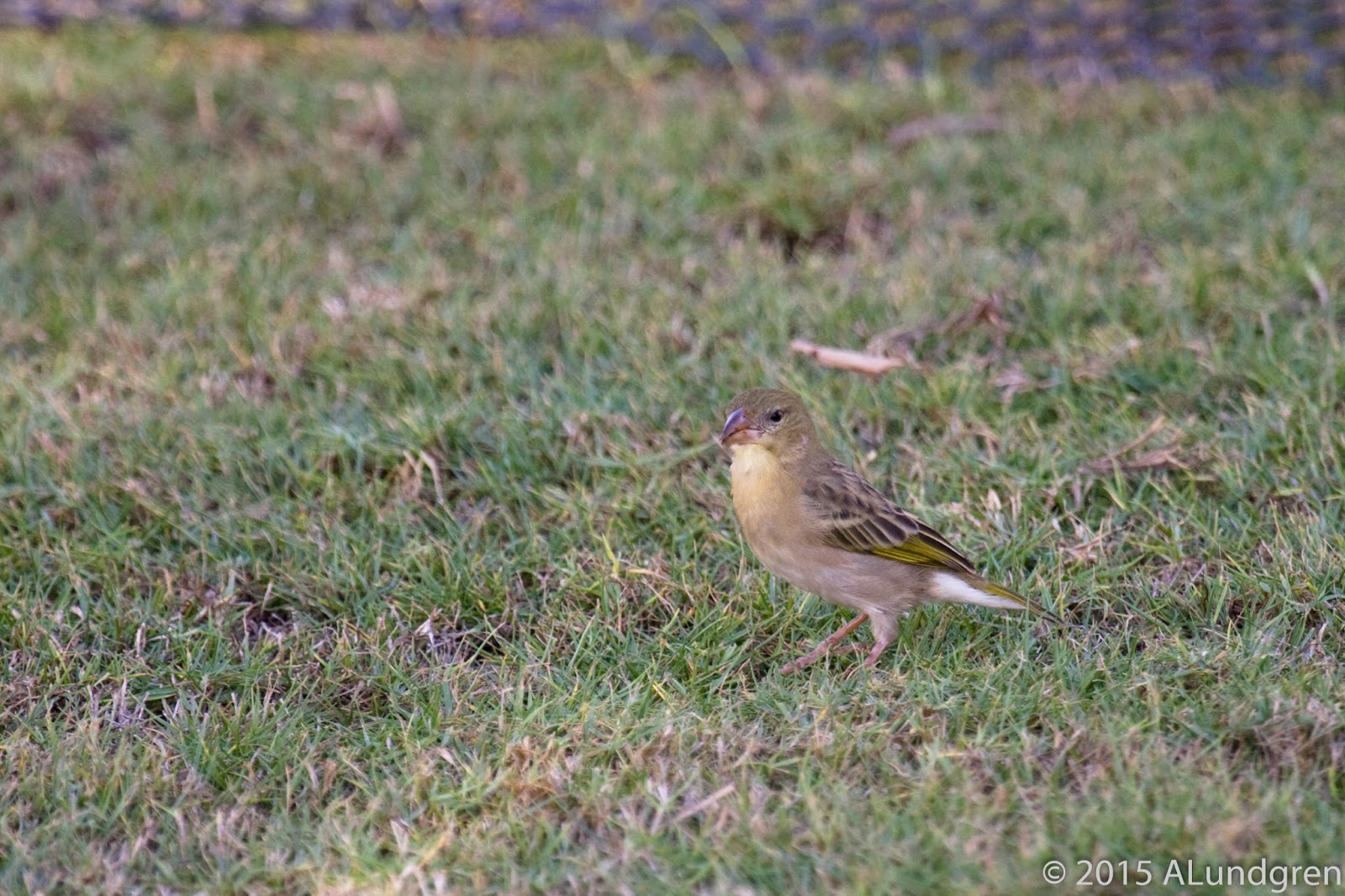
onsdag 13 juli 2016

Birding in Oman Nov -15 Ayn Razat, Ayn Hamran, Ayn Tobroq

Ok, I'm ashamed... It's been five months since the last blogpost from Oman and I really have no other excuses other than that everything else seemed like a higher priority. Might have something to do with the anti virus program erasing about five or six hours of typing in my previous post (which was about the Khawrs we visited)

This post will cover, what I consider, more interesting nature types, namely the Ayns we visited. I don't really know what Ayn means (eye according to one source) but it seems to be the place where a wadi is opening up to the plane below the mountains. Just by the foot of the mountain.

Anyway, as I write these posts in a both chronological and biotop order this first place is where we ended up on the morning the second day (the 17th of November). This is Ayn Razat, check this link out for a google map, Ayn Razat is the only green place on the map, just at the foot of the Dhofar mountain range. For me, Ayn Razat was the highlight so far during the trip. Even though Khawr Rawri gave us great many species, mountain regions are always special to me. For starters, the silence of the mountains is soothing, after a couple of days in a busy city zone, and Ayn Razat (and the other Ayns as well) was just that. Much like Wadi Bih and Masafi Wadi in UAE.

We brought breakfast from the hotel, which we ate while the sun was rising. Around us we could hear and see Cinnamon-breasted Buntings, Abyssinian White-eyes, Blackstarts and a Grey Wagtail. A few Palestine Sunbirds and quite a few Afrikan mParadise Flycatchers. 

After the breakfast, we started walking up the wadi. As we were quite a large group, we were quite slow... Over the head, a couple of fan tailed ravens could be seen and in the bushes were several Arabian warblers. At the farthest point of the wadi, which we walked to (this was not far up the wade) we found at least three Black-Crowned Tchagras. Also Blue Rock Thrush was seen and one person in the group saw Striolated bunting and probably also a Merlin. If I would go back to Ayn Razat, at some point, I would definitely roam further up the wadi... 

We headed back to the place where we had parked the cars, for a walk in the small botanical garden, which can be found here. On the way we saw a Wild Cat and then someone said that he had seen a Masked Shrike. I know that I have a thing for shrikes and, as I had been searching for the Masked shrike in Safa Park in UAE on more than one occasion, I was quite keen on seeing this bird. In the end we all succeded but we didn't get very close. Two Short-toed Snake Eagles were also seen by the parking area. One of these were seen very shortly further up in the wadi as well but not they rally showed themselves. After this, into the garden we went.

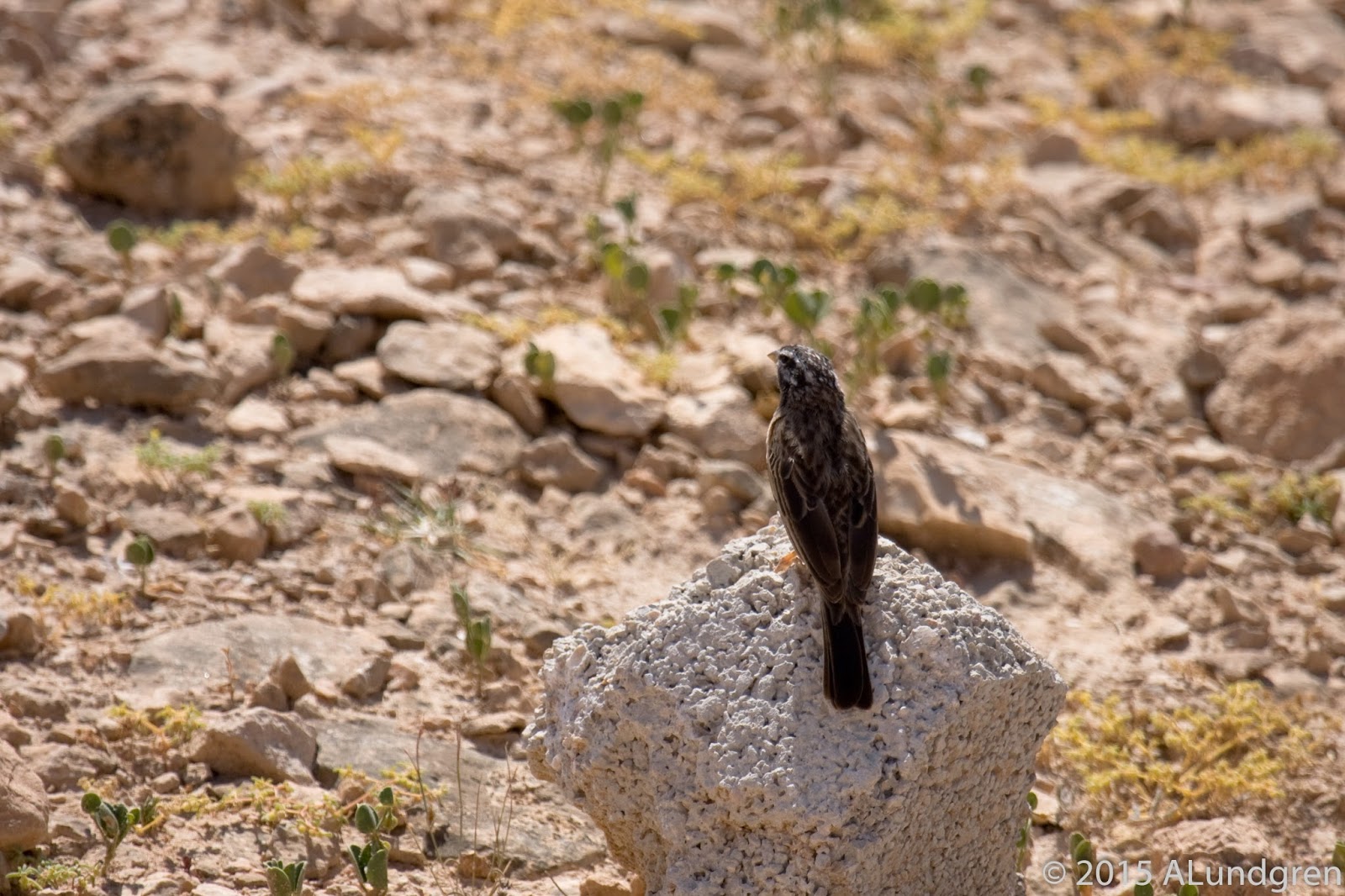
Cinnamon-breasted Bunting (zebrasparv, Emberiza tahapisi)
The Cinnamon-breasted Bunting was very common in the Ayns. A beautiful bird which looks quite like the Striolated bunting. For comparison, I have photos of Striolated if you follow this link.
Arabian Warbler (arabisk sångare, Sylvia leucomelaena)
It was still quite early in the morning when we walked up the valley (the Wadi) and with the relatively steep slopes to the side, it took some time for the sun to show. Thus the poor light in some of the photos. Here an Arabian Warbler.
Black-crowned Tchagra (svartkronad tchagra, Tchagra 
senegalus)
One of the target species for me during this trip was the Black-crowned Tchagra. So when I found this one I was very happy. However, this species turned out to be not quite as rare as I believed. Nice bird none the less.
Blackstart (svartstjärt, Oenanthe melanura)
Blackstarts could be seen in many places in Oman.
Cinnamon-breasted Bunting (zebrasparv, Emberiza tahapisi)
Another Cinnamon-breasted Bunting but by now the sun had started to show.
African Wild Cat (afrikansk vildkatt, Felis silvestris lybicus)
This Wild Cat did not seem very wild at all. It was actually sleeping under one of our cars at one point.
Blue Rock Thrush (blåtrast, Monticola solitarius)
Ok, pictures are not entirely in correct order. This female Blue Rock Thrush was actually seen before the Wild Cat
Into the garden we went. This was supposed to be a decent place for Bruce's Green Pigeon and it didn't let us down. Another first for the trip was the Scaly-breasted Munia, obviously an introduced species but I would suspect that it is self sustaining at this point since we saw it in more places during the trip. Hoopoes and more Aftican Paradise Flycatchers could be seen in the park and suddenly someone shouted. I saw a big bird flying off the ground and I instinctively thought it looked like a raptor of some sort. This turned out to be false, though... After quite som search in the trees at the western end of the park one of us (I think it was Gigi... Hmmm) found it. A Spotted Eagle Owl. Wow! This was not expected and a real treat.
Bruce's Green Pigeon (gulbukig grönduva, Treron waalia)
A master of disguise... As colorfuls as it is, the Bruce's Green Pigeon can be extremely difficult to find, even if you know where it is.
African Paradise Flycatcher (afrikansk paradismonark, 
Terpsiphone viridis)
The long tail feathers of the male African Paradise Flycatcher makes it quite spectacular.
Long-billed Pipit (långnäbbad piplärka, Anthus similis)
While waiting for someone to spot the Spotted Eagle Owl, this Long-billed pipit showed itself from just a few meeters away.
Spotted Eagle-Owl (fläckuv, Bubo 
africanus)
There it is, the Spotted Eagle Owl. Unfortunately, no matter how I positioned myself, I never got a clear shot of the bird. But still, a beautiful species.
Spotted Eagle-Owl (fläckuv, Bubo 
africanus)

Palestine Sunbird (palestinasolfågel, Cinnyris osea)
On the way back to the cars, one of the other photografers in the group took some time to get nice photos of this Palestine sunbird. Very nice blue colours.
Palestine Sunbird (palestinasolfågel, Cinnyris osea)

I speeded ahead of the group, I wanted a second chance at the Masked Shrike. This time, when I was alone, I had more luck. I couple of decent photos of this extrordinary bird. For me, that is...
Masked Shrike (masktörnskata, Lanius nubicus)

Masked Shrike (masktörnskata, Lanius nubicus)
This photo is, of course, more or less the same as the one above but I just like the bird so I ended up with both photos in this blog...
After leaving Ayn Razat, we went back to the hotel for a lunch at the seaside restaurant. More about that lunch can be found in the startup blog post for this trip to Oman.

After the lunch, we drove back towards the Dhofar mountains but this time to Ayn Hamran. In many ways similar to Ayn Razat but still quite different. Mostly because we visitid the place in the afternoon. Here is a google map of Ayn Hamran. There were quite a few raptors; Bonelli's Eagle, Short-toed Snake Eagle, Lesser Kestrel, etc, and also another Black-crowned Tchagra, a couple of Arabian warblers and these amazing spiders. Som kind of silk spiders. But we were specifically here to wait for dusk. This is a good place to listen for Arabian Scops Owl. In the end we heard at least seven individuals. But the coolest thing about this evening was when a muezzin was calling from a nearby tower after dusk. Wolves started howling in response to the muezzin. Very cool, indeed.
African Wild Cat (afrikansk vildkatt, Felis silvestris lybicus)
On the way to Ayn Hamran, just before we reached the parking place, another wild cat was found walking beside the road. It did not seem to be as well nourished as the one in Ayn Hamran.
Abyssinian White-eye (abessinsk glasögonfågel , Zosterops 
abyssinicus)
Abyssinian White-eyes were a common sight pretty much evereywhere.
Arabian Warbler (arabisk sångare, Sylvia leucomelaena)
While wating for dusk to arrive, I spent some time working with an Arabian Warbler in persuit of some decent photos. Wasn't easy...
White-spectacled Bulbul (levantbulbyl, Pycnonotus 
xanthopygos)
The White-spectacled Bulbyl was more accomodating than the Warbler.
Hej
The Desert Wheatears were common. But always nice to see. Beautiful birds.
Unidentified species of Dragonfly
I tried to capture some dragonflies. The species of this one has eluded me so far. Difficult...
Black-crowned Tchagra (svartkronad tchagra, Tchagra 
senegalus)
As I wrote above, another Black-crowned Tchagra was found here in Ayn Hamran. Always staying low in the bushes or on the ground. Very seldom motionless for more than a second.
Really large spider
Fascinating spiders can be found here in Ayn Hamran. This one - including legs - was about as large as my palm. The threads were thick enough to really make themselves felt whenever you went into one.
There were, of course, no photos of the Arabian Scops Owl, they could only be heard after dark, and this was it for this visit in Ayn Hamran. Already on the way back in the car, we talked about how we would like to visit again, but in the morning instead. We didn't have another visit planned in the itinerary for the trip but we knew that there was supposed to be a couple of mornings free close to the end of the trip. So, on the day when we were going to Al Mugsahul in the afternoon - the 22nd of November - the guys in my car decided that we wanted to go to Ayn Hamran again. In the end, our trip leader included another morning in Ayn Hamran, on the 24th, but we didn't mind. It was a nice place to go birding and at this point we had seen neither the Arabian Golden-winged Grosbeak nor the Dideric cuckoo. Both of which were target species for, at least, myself.

So, in the morning of the 22nd, we drove quite early to Ayn Hamran, with the deadline being that we needed to get back before the hotel finished serving breakfast. The photos below shows quite well the outcome of this visit.
Arabian Partridge (arabisk rödhöna, Alectoris melanocephala)
As can be seen by the light in the photo, this was still early. A family of Arabian partridges was walking on the valley floor. Another new species for me.
Black-crowned Tchagra (svartkronad tchagra, Tchagra 
senegalus)
The Tchagras could easily be seen. It seems that they got easier and easier to see as the trip progressed. Here in quite a typical pose.
Cinnamon-breasted Bunting (zebrasparv, Emberiza tahapisi)
In the early morning light, the Cinnamon-breasted Buntings came down to the small concrete waterway to drink. Along with a Grey Wagtail.
Arabian Golden-winged Grosbeak (arabisk guldvingefink, 
Rhynchostruthus percivali)
Then finally my father called out. He had seen an Arabian Golden-winged Grosbeak. I just saw it before it flew off but I managed to get this shot of the bird. The other two guys were not so lucky. They didn't see this bird.
Arabian Warbler (arabisk sångare, Sylvia leucomelaena)
While searching for the Grosbeaks, this Arabian Warbler didn't care at all about me and finally I got some clear shots of the bird.
Arabian Warbler (arabisk sångare, Sylvia leucomelaena)

Arabian Golden-winged Grosbeak (arabisk guldvingefink, 
Rhynchostruthus percivali)
A little later, my father called again. The Grosbeaks were back. This time all of us got to see the birds and this time they were quite accomodating. Beautiful birds! So here are a couple of photos of them
Arabian Golden-winged Grosbeak (arabisk guldvingefink, 
Rhynchostruthus percivali)


Arabian Golden-winged Grosbeak (arabisk guldvingefink, 
Rhynchostruthus percivali)

The Dideric Cuckoo was elusive. We didn't see it this time around and not the next time either. One of the few birds that is a clear incentive for me - birdingwize - to go back to Oman. Though, I guess it can be seen in other places as well. 

On the 24th, we drove back to Ayn Hamran, now with the whole crew. As I had, by this time, been here twice before, I started to extend the search area a little bit. First I went further up the hills surrounding the Ayn but with limited result. A Wryneck and a Blue Rock Thrush were the only intreresting species. Instead I started walking down the valley, by the stream. This was interesting and I can recommend doing that. In the short time I had at my disposal I found another Masked Shrike, several Bruce's Green Pigeons, Isabelline Shrike, probably a Northern Wheatear and beautiful views of a Black-crowned Tchagra. I wish I had had more time...
Steppe Eagle (stäppörn, Aquila nipalensis)
Steppe Eagle, on the way to Ayn Hamran
Red Fox (Rödräv, Vulpes vulpes arabica)
Red Fox, arabian sub species?
Steppe Eagle (stäppörn, Aquila nipalensis)
Spotted Eagle again
Eurasian Wryneck (göktyta, Jynx torquilla)
The Wryneck was difficult to get clear shots of. This had to do...
Blue Rock Thrush (blåtrast, Monticola solitarius)
A male Blue Rock Thrush. Always beautiful
View over Ayn Hamran
A photo taken from one of the hills surrounding the Ayn. In the middle you can see the sand flor of the valley.
African Paradise Flycatcher (afrikansk paradismonark, 
Terpsiphone viridis)

Isabelline Shrike (isabellatörnskata, Lanius isabellinus)
1 cy Isabelline Shrike
Isabelline Shrike (isabellatörnskata, Lanius isabellinus)

Black-crowned Tchagra (svartkronad tchagra, Tchagra 
senegalus)

In the eavning of the 19th we drove to a water station (just a water hose) close to Ayn Tobroq. Check out this map of exact location. The place of the water station is centered in the map. You can see a little bit of green in the centre of the map. This is a place where a large flock of Lichtenstein's sandgrouse come to drink, just after sunset. We were also lucky and all in all we counted 61 indivuduals.
Lichtenstein's Sandgrouse (strimmig flyghöna, Pterocles 
lichtensteinii)
Very blurry, taken with phone through scope at very poor light.
This was it from these places. I hope it will not take this long to get to the next one, which will be about the pelagic we did and what we found in Al Mugsahul.

Species list for Ayn Razat (as in earlier posts, I leave out the most common ones). New lifers marked with *.
Palestine Sunbird (palestinasolfågel, Cinnyris osea) *
African Paradise Flycatcher (afrikansk paradismonark, Terpsiphone viridis)
Cinnamon-breasted Bunting (zebrasparv, Emberiza tahapisi)
White-spectacled Bulbul (levantbulbyl, Pycnonotus xanthopygos)
Abyssinian White-eye (abessinsk glasögonfågel , Zosterops abyssinicus)
Blackstart (svartstjärt, Oenanthe melanura)
White Wagtail (sädesärla, Motacilla alba)
Common Kestrel (tornfalk, Falco tinnunculus)
Shining Sunbird (abessinsk solfågel, Cinnyris habessinicus)
Blue-cheeked Bee-eater (grön biätare, Merops persicus)
Grey Heron (gråhäger, Ardea cinerea)
Fan-tailed Raven (kortstjärtad korp, Corvus rhipidurus) *
Grey Wagtail (forsärla, Motacilla cinerea)
Graceful Prinia (streckig prinia, Prinia gracilis)
Arabian Warbler (arabisk sångare, Sylvia leucomelaena) *
Black-crowned Tchagra (svartkronad tchagra, Tchagra senegalus) *
Blue Rock Thrush (blåtrast, Monticola solitarius)
Short-toed Snake Eagle (ormörn, Circaetus gallicus) *
Masked Shrike (masktörnskata, Lanius nubicus) *
Bruce's Green Pigeon (gulbukig grönduva, Treron waalia) *
Tristram's Starling (sinaiglansstare, Onychognathus tristramii)
Spotted Eagle-Owl (fläckuv, Bubo africanus) *
Long-billed Pipit (långnäbbad piplärka, Anthus similis)
Eurasian Hoopoe (härfågel, Upupa epops)
Scaly-breasted Munia (fjällig munia, Lonchura punctulata)
African Wild Cat (afrikansk vildkatt, Felis silvestris lybicus)


Species list for Ayn Hamran
Bonelli's Eagle (hökörn, Aquila fasciata)
Lesser Kestrel (rödfalk, Falco naumanni)
Arabian Scops Owl (arabisk dvärguv, Otus pamelae) *
Wolf (Varg, Canis lupus arabs)
African Wild Cat (afrikansk vildkatt, Felis silvestris lybicus)
Eurasian Hoopoe (härfågel, Upupa epops)
Eurasian Wryneck (göktyta, Jynx torquilla)
Arabian Golden-winged Grosbeak (arabisk guldvingefink, Rhynchostruthus percivali) *
African Paradise Flycatcher (afrikansk paradismonark, Terpsiphone viridis)
Arabian Partridge (arabisk rödhöna, Alectoris melanocephala) *
Black-crowned Tchagra (svartkronad tchagra, Tchagra senegalus)
Arabian Warbler (arabisk sångare, Sylvia leucomelaena)
Palestine Sunbird (palestinasolfågel, Cinnyris osea)
Lesser Whitethroat (ärtsångare, Sylvia curruca)
Grey Wagtail (forsärla, Motacilla cinerea)
Masked Shrike (masktörnskata, Lanius nubicus)
Isabelline Shrike (isabellatörnskata, Lanius isabellinus)
Green Bee-eater (grön dvärgbiätare, Merops orientalis)
Bruce's Green Pigeon (gulbukig grönduva, Treron waalia)
Blue Rock Thrush (blåtrast, Monticola solitarius)
Steppe Eagle (stäppörn, Aquila nipalensis)
Red Fox (Rödräv, Vulpes vulpes arabica)

Ayn Tobroq doesn't really need a species list but...
Lichtenstein's Sandgrouse (strimmig flyghöna, Pterocles lichtensteinii)
Unidentified Isabelline/Turkestan Shrike (Oidentifierad isbella/turkestantörnskata, Lanius ??)

torsdag 25 februari 2016

Birding in Oman, Nov -15 Khawr Rawri, Khawr Taqah, East Khawr

This is the second time I write this blog post... When I had just about finished it the first time my anti virus program flashed a popup promting me to restart the computer. As I was writing when this happened, one of the keys I pressed restarted the computer without me having any time to do anything about it. About 5-6 hours of work was gone... even though I had pressed save many times. I hope I can manage to write everything again.

Well, in any case. This blog post takes us back to the first day (the 16th) of the birding trip in Oman again. After a long night's flight, an early morning birding tour of the hotel garden and its proximity and an hour and a half of sleep, the group got together by the cars. The plan was to drive to the large Khawr, in the eastern part of the Salalah area, called Khawr Rawri. 

We headed off for the Khawr but stopped for supplies. We bought bananas and other fruit at some fruit stands by the road. By the way, the bananas are something different than what we have in sweeden. The short, sweet ones were very nice. Also they were grown just beside the stands. We also filled up with water, bread and some nuts. But a tip here is to bring salty nuts from home. I didn't find any in the small shops and as you sweat a lot it's a good thing to have while away from the hotel.

Some 30-40 minutes drive to the Khawr and as it lies within the area of a world heritage site, there was an entrance fee. Not expensive though. The hole Khawr Rawri (or Khor Rori or Khawr Ruri or whatever it is called) used to be an ancient port, important in the trading of the frankincense and the ruins of the town Sumhuram are still left and used as tourist attractions.

We drove down the eastern side of the Khawr, almost all the way down to the beach. Here we got our scopes out of the car and started birding for real. Though we had already seen both Cinnamon-breasted Bunting and Eastern Imperial Eagle on the way down.

We soon saw Isabelline Wheatear, Squacco Heron, Cotton Pygmy Goose, Pacific Golden Plover etc. when going to the edge of the Khawr. I think this was a good place to start as it allowed for some easy birding and quite a lot of species. The trip list grew at a fast pace...


View of Khawr Rawri
The photo shows Khawr Rawri, in the distance, and part of the plane land between the Dhofar mountains and the Indian Ocean. The photo is taken from the road to Wade Darbat. The Khawr lies with only a thin strip of sandy beach separating it from the ocean. It can be seen between the two "mountains" (for lack of better word) just by the ocean.

Cinnamon-breasted Bunting (zebrasparv, Emberiza tahapisi)
While our tour guide payed the entrance fee on of the group (I think it was my dad, in fact) found the first Cinnamon-breasted Bunting for the trip. As always, the first bird of a species is always special and at this point we didn't know that it was very common in the Dhofar mountains.

Eastern Imperial Eagle (kejsarörn, Aquila heliaca)
The first raptor lifer for the trip turned out to be this Eastern Imperial Eagle, which showed itself on the way down to the beach.
Even though there was a lot of birds down at the Khawr, the photo opportunities were few. The sun was not in our favour and many of the birds were quite some distance away from us. But is was really nice anyway. Slender-billed gulls flew back and forth between the Khawr and the ocean, as did the Saunders's Terns. Some in the group saw an Intermediate Egret, which I missed. Or... I might have seen it but I couldn't really say that it was an Intermedieat. With no other birds to tell the relative size and never having seen it before, well... I'll see it some other time. Though I think it was the only species seen by the group, that I missed, which would have been a new lifer for me. No, there were probably a few more... I think I wrote about a Jouanin's Petrel in the first post of the trip to Oman.

Never mind. It was a very nice afternoon down by the Khawr.

Slender-billed Gull (långnäbbad mås, Chroicocephalus genei)
A quite common species along the coast. This was the first sighting for me though.
After some time in the sun we went down to the beach for a swim. Warm water, nice waves and a deserted paradise beach. It couldn't get much better than this. Also perfect timing after the flight, lack of sleep and the heat while birding. Really nice!! If one would go to Oman with the family, I cannot think of a better place to go to. 

The beach by Khawr Rawri
About 500 meters of perfect, pristine beach, which goes even further in the other direction compared to the photo. Not a single person to be seen.
After cooling ourselves in the Indian ocean for a while it was time go move a short distans. We drove back up to the ruins of Sumhuram where we wanted to look for Blackstart, in particular. Well, it turned out to be easy to find the Blackstart and took a walk around the ruins to check them out a little bit further. A very nice featuri in birding trips like this one, to also be able to visit a world heritage site. 

The ruins of the city Sumhuram
A nice walkway is going around the ruins of this city. Not only the Blackstart but also Desert Wheatear, Isabelline Shrike and a couple of other species could be seen. If you want to know more about Sumhuram follow this link.
Khawr Rawri
The view over the southernmost part of Khawr Rawri, from the ruins of Sumhuram
Back at the parking lot, I was one of the first and while we waited for the rest of the group to catch up, one of the others in the group and I went a little closer to small busher close by. A few birds could be seen feeding there. A nice male Shining sunbird, which didn't seem too bothered by our precence, and a couple of African Silverbills found something to eat on the ground.

Shining Sunbird (abessinsk solfågel, Cinnyris habessinicus)
I chose to include two photos of this beautiful, male Shining sunbird as they show how different it can look just a couple of seconds apart. In this photo, it looks almost completely black with a greenish tinge from the ear coverts, down the neck towards the lesser coverts on the wing. Check out the next photo for comparison
Shining Sunbird (abessinsk solfågel, Cinnyris habessinicus)
In this photo, the green tinge is still there but now accompanied by both red and blue on the throat and neck. Quite different appearance...
African Silverbill (afrikansk silvernäbb, Euodice cantans)

House Sparrow (gråsparv, Passer domesticus)
The first House Sparrow of the trip was also found at Sumhuram. I was a little bit surprised to find it here, in the middle of the desert but then again this was a tourist spot so perhaps I shouldn't have been surprised at all...
As the sun started its descent towards the horizon, we left the world heritage site and drove a short distance to the northernmost part of the Khawr. It is a different kind of biotope here with a decent sized reed area and a more marshland type than open water. Then just beside the reed it is quite dry with a lot of lower bushes. Immediately on arrival, the first Red-backed Shrike was found and a few in the group saw a Little Bittern. The Bittern was another species which I have never seen, I remember now...

The main target species in this part of the Khawr was the Clamorous Reed Warbler, which could be heard here and there in the reed. A Baillon's Crake was a nice addition to the list and the first Chiffchaffs of the trip were seen. Some of the group flushed a Pin-tailed Snipe but at least, this was one species I had already seen in UAE.

Baillon's Crake (dvärgsumphöna, Porzana pusilla)
The little crake in the picture showed itself during a long time but it was quite dark and getting decent photos proved difficult. In the end we could at least use the photos to tell that it wasn't a Little Crake but rather a Baillon's
African Monarch (afrikansk monark, Danaus chrysippus)
The first African Monarch was also a nice find. It turned out to be relatively common, in particular in Ayn Razat, where we saw several dozen. Beautiful butterfly!
That was it for Khawr Rawri and we didn't go back to this place again during the trip. At least not while I was in Oman. As we were flying from two locations, Copenhagen and Stockholm, we didn't go home on the same day. I was flying to Copenhagen and we had to leave a day earlier than the ones going to Stockholm. These guys went back to Khawr Rawri on the extra day they had. I heard that they had seen Scrub Warbler during this visit. It would have been nice to see but at least a bird I have seen before (link to blog post in which I have photos of Scrub Warbler) in the UAE.

Next Khawr i want to write about here is East Khawr, or Khawr ad Dahariz as it says on google maps. We went to this site three times (at least the car I was riding in), on the 18th, the 22nd and the 24th. 

East Khawr is easily accessed by the road going between the ocean and the Khawr itself. This is also the best place to put your scopes up as the edge of the Khawr to the road is good for shorebirds, herons and ibisis etc. Another part of this site which should not be missed is the beach over at the ocean. It is only a short walk to the ocean. 

The reason for three stops at this site was partly due to the easy access but also partly because we had been told that there was a Long-toed Stint there. We thought we saw the stint for a short while during the last visit but it wasn't a good view and then the hole group of stints was flushed and we couldn't find it again. That one will have to wait for another time.

Even though there were quite a lot of species at East Khawr, Garganay, Reef Heron, Cattle Egrett etc. only one new lifer was seen here during the first visit. This was a Pheasant-taile Jacana, which I managed to spot myself. A Broad-billed Sandpiper made up, to some extent, for the non existing Long-toed Stint (it wasn't until the last visit we had that short sighting of what could have been it), Temmink's Stint, Saunders's Tern and Lesser Sand Plover were other species seen there.

 Link to map showing East Khawr

Greater Flamingo (större flamingo, Phoenicopterus roseus)

Squacco Heron was common but distiguishing it from Indian Pond is not very easy. We believe that most of the Squacco/Pond Herons we saw were in fact Squacco and we only had one individual which we was certain was an Indian Pond.
Squacco Heron (rallhäger, Ardeola ralloides)
Fishin' pose!
Sooty Gull (sotmås, Ichthyaetus hemprichii)
There were Sooty gulls all along the watchtower... I mean shoreline.
Both on the first and the last visit, we went down to the beach. A few Lesser Sand Plovers could be seen here and Eurasian Oystercatcher in winter plumage, but it wasn't until the last visit that we saw the two Greater Sand Plovers. 

One thing you should always do when you are close to the shore is to watch the ocean. During our last visit to the Khawr, I kept a special lookout over the open water. I was a bit annoyed that I had missed the Masked Booby some of us saw while having lunch in the hotel beach restaurant one of the first days. It was just lazyness on my part, I could have got up to see it but I just thought it was a sure bet when we would go to Al Mughsayl. Turned out to be not quite that easy... Anyway, I suddenly spotted one, not quite adult but not a 1cy either. Some of the others thought I wanted too see the Masked Booby to much and had in fact seen a Brown Booby... That's because suddenly there were both a Masked and a Brown in the same place, almost. Well, everyone got to see the Masked in the end. :-)

Kentish Plover (svartbent strandpipare, Charadrius alexandrinus)
Kentish Plovers were common on the ocean beach and by the Khawrs. If you take your time, I sure you could have managed to get real closeups but I never took the time to do that.
Greater Sand Plover (ökenpipare, Charadrius leschenaultii)
In the end, there it was, the Greater Sand Plover. I had seen it a couple of times in the UAE but it's still a nice bird.
Beach birding
Part of the group of Swedish birders who was on this trip. By this time I imagine that many where quite tired after almost ten days of birding and many early mornings.
Eurasian Oystercatcher (strandskata, Haematopus ostralegus)
Another try with digiscoping. An Oystercatcher of what used to think was a different sub species but rather is the winter plumage... I have not really studied longipes or osculans or whatever one might expect to see.
The last visit to East Khawr was also one of the last sites we visited while we were in Oman (except for the ones flying from Stockholm of course) and we were trying to get the last few species to reach 200 for the trip. Not that we took it very seriously but it seemed a nice number to reach and one none in the group thought we would reach. So, as we searched through the birds, we found a Pied Avocet, first for the trip and just when it was time to leave, Magnus called out and said he saw a new species for the trip. A Pallas's Gull. This also became the last lifer for me on this trip.

Pallas's Gull (svarthuvad trut, Ichthyaetus ichthyaetus)
Not that it is particularly beautiful - at least not compared to the Verreaux' Eagles we saw - (in another blog post...) but still really cool. If I'm not mistaken, this must be a 1cy bird.
The third Khawr we visited - or perhaps tried to visit is a better sentence - was Khawr Taqah. This was on the 20th. Unfortunately is was very exploited and the entire nort shore was made into some kind of park, which was closed. The southern side was almost completely blocked by reed which made the spots with open water both few and small. We soon gave up and drove on towards Wadi Darbat instead. We did see the first definite Southern Grey Shrike here though. We had seen a grey Shrike before but I'm actually believing that it was a Steppe. But as that is a subspecies of Southern Gray, at least according to some lists, well I think I'll just let that one go.

Wood Sandpiper (grönbena, Tringa glareola)
Photo taken from the car

Pheasant-tailed Jacana (fasanjaçana, Hydrophasianus chirurgus)
In one of the few open waters in Khawr Taqah we saw at least five Pheasant-tailed Jacanas. A Common Moorhen behind the Jacana
It's time to wrap this blog post up. The two large Khawrs, East and Rawri are really worth a visit. If the park at Khawr Taqah opens up it might be a bit easier to go birding there compared to when we tried. There are also quite a few more Khawrs which probably are good as well. Many seem to be quite exploited with a lot of the natural water front (reed etc. ) being concrete or whatever. Too bad. 

Next post will cover the Ayns we visited. Stay tuned :-)

New lifers for me are marked with * in the species lists below.

Species list for Khawr Rawri (in more or less chronological order)
Cinnamon-breasted Bunting (zebrasparv, Emberiza tahapisi) *
Eastern Imperial Eagle (kejsarörn, Aquila heliaca) *
Common Redshank (rödbena, Tringa totanus)
Glossy Ibis (bronsibis, Plegadis falcinellus)
Squacco Heron (rallhäger, Ardeola ralloides)
Common Moorhen (rörhöna, Gallinula chloropus)
Isabelline Wheatear (isabellastenskvätta, Oenanthe isabellina)
Kentish Plover (svartbent strandpipare, Charadrius alexandrinus)
Northern Shoveler (skedand, Anas clypeata)
Greater Flamingo (större flamingo, Phoenicopterus roseus)
Slender-billed Gull (långnäbbad mås, Chroicocephalus genei)
Citrine Wagtail (citronärla, Motacilla citreola)
Cotton Pygmy Goose (bomullsdvärgand, Nettapus coromandelianus) *
Western Reef Heron (revhäger, Egretta gularis)
Pacific Golden Plover (sibirisk tundrapipare, Pluvialis fulva) *
Rock Dove (klippduva, Columba livia)
Little Grebe (smådopping, Tachybaptus ruficollis)
Common Ringed Plover (större strandpipare, Charadrius hiaticula)
Sandwich Tern (kentsk tärna, Thalasseus sandvicensis)
Eurasian Spoonbill (skedstork, Platalea leucorodia)
Marsh Sandpiper (dammsnäppa, Tringa stagnatilis)
Black-tailed Godwit (rödspov, Limosa limosa)
Ruff (brushane, Philomachus pugnax)
Eurasian Teal (kricka, Anas crecca)
Black-winged Stilt (styltlöpare, Himantopus himantopus)
Northern Pintail (stjärtand, Anas acuta)
Dunlin (kärrsnäppa, Calidris alpina)
Little Stint (småsnäppa, Calidris minuta)
Indian Pond Heron (rishäger, Ardeola grayii)
Western Marsh Harrier (brun kärrhök, Circus aeruginosus)
Saunders's Tern (Saunders småtärna, Sternula saundersi) *
Common Snipe (enkelbeckasin, Gallinago gallinago)
Eurasian Wigeon (bläsand, Anas penelope)
Greater Spotted Eagle (större skrikörn, Clanga clanga)
Blue-cheeked Bee-eater (grön biätare, Merops persicus)
Isabelline Shrike (isabellatörnskata, Lanius isabellinus)
Blackstart (svartstjärt, Oenanthe melanura) *
Crested Lark (tofslärka, Galerida cristata)
African Silverbill (afrikansk silvernäbb, Euodice cantans)
House Sparrow (gråsparv, Passer domesticus)
Bluethroat (blåhake, Luscinia svecica)
Shining Sunbird (abessinsk solfågel, Cinnyris habessinicus)
Green Bee-eater (grön dvärgbiätare, Merops orientalis)
Red-backed Shrike (törnskata, Lanius collurio)
Green Sandpiper (skogssnäppa, Tringa ochropus)
Wood Sandpiper (grönbena, Tringa glareola)
Clamorous Reed Warbler (papyrussångare, Acrocephalus stentoreus) * Though I very probably saw one at Dubai Pivot Fields last year.
Baillon's Crake (dvärgsumphöna, Porzana pusilla) *
Sand Martin (backsvala, Riparia riparia)
Common Chiffchaff (gransångare, Phylloscopus collybita)
African Paradise Flycatcher (afrikansk paradismonark, Terpsiphone viridis)
African Monarch (afrikansk monark, Danaus chrysippus), Butterfly

Species list for East Khawr (including the beach south of the Khawr. Some of the more common species are not in the list):
Pheasant-tailed Jacana (fasanjaçana, Hydrophasianus chirurgus) *
Western Reef Heron (revhäger, Egretta gularis)
Great Egret (ägretthäger, Ardea alba)
Glossy Ibis (bronsibis, Plegadis falcinellus)
Garganey (årta, Anas querquedula)
Little Egret (silkeshäger, Egretta garzetta)
Eurasian Coot (sothöna, Fulica atra)
Northern Pintail (stjärtand, Anas acuta)
Greater Flamingo (större flamingo, Phoenicopterus roseus)
Eurasian Spoonbill (skedstork, Platalea leucorodia)
Squacco Heron (rallhäger, Ardeola ralloides)
Western Cattle Egret (kohäger, Bubulcus ibis)
Citrine Wagtail (citronärla, Motacilla citreola)
Western Marsh Harrier (brun kärrhök, Circus aeruginosus)
Common Moorhen (rörhöna, Gallinula chloropus)
Grey Plover (kustpipare, Pluvialis squatarola)
Sooty Gull (sotmås, Ichthyaetus hemprichii)
Common Ringed Plover (större strandpipare, Charadrius hiaticula)
Lesser Sand Plover (mongolpipare, Charadrius mongolus)
Kentish Plover (svartbent strandpipare, Charadrius alexandrinus)
Common Snipe (enkelbeckasin, Gallinago gallinago)
Common Redshank (rödbena, Tringa totanus)
Common Greenshank (gluttsnäppa, Tringa nebularia)
Wood Sandpiper (grönbena, Tringa glareola)
Sanderling (sandlöpare, Calidris alba)
Little Stint (småsnäppa, Calidris minuta)
Temminck's Stint (mosnäppa, Calidris temminckii)
Dunlin (kärrsnäppa, Calidris alpina)
Broad-billed Sandpiper (myrsnäppa, Limicola falcinellus)
Ruff (brushane, Philomachus pugnax)
Saunders's Tern (Saunders småtärna, Sternula saundersi)
Pied Avocet (skärfläcka, Recurvirostra avosetta)
Greater Sand Plover (ökenpipare, Charadrius leschenaultii)
Eurasian Oystercatcher (strandskata, Haematopus ostralegus)
Masked Booby (masksula, Sula dactylatra) *
Pallas's Gull (svarthuvad trut, Ichthyaetus ichthyaetus) *

Species list for Khawr Taqah (many of the more common species were seen here as well but I will not type them here):
Blue-cheeked Bee-eater (grön biätare, Merops persicus)
Southern Grey Shrike (iberisk varfågel/ökenvarfågel (44), Lanius meridionalis)
Bluethroat (blåhake, Luscinia svecica)
Pheasant-tailed Jacana (fasanjaçana, Hydrophasianus chirurgus)

torsdag 4 februari 2016

Birding in Oman, November 2015 - Crowne Plaza Hotel

In november 2015 I participated in a birding trip to Oman and more specifically to the Salalah area. It was my first ever trip abroad which was solely focusing on birding and it was a fantastic experience. As I have two kids at home (6 and 4 years old), being able to practise you hobby for ten straight days was a pure luxury. The trip was arranged by Swedish birding trip company AviFauna and was considered a "one Stork" trip on a scale from one to three. However, many of the participants used the early morning light to explore the surroundings of the hotel, rather than sleeping and a few extra morning tours where held, so our guide - Gigi Sahlstrand - (I hope it is ok that I mention your name here Gigi) upgraded the trip to a two Stork trip. :-)

When writing this, I have the ambition to write a series of blogposts to describe the sites we visited and which birds we saw at the respective site. Now, to be fair, I will not write the species names of the most common over and over again... Collared Doves can be seen everywhere.

These blogposts will focus on my own experiences of the sites and also the species covered will be my own sightings, though I might mention species seen by the other members of the party if I remember them. In the end, this blog is really only to have some firmer memories of the trip for myself, but I make them public just in case someone would find them useful. I will also put a few photos into the posts. Not that they are particularly good but they are all a little bit special to me in one way or another.

As I complete the posts, I will put some links here in the first post.
-Sixth and last post: Mudayy, Wadi Darbat, East Khawr Park and Jabal Samhan

So, Crowne Plaza Hotel. We arrived at the hotel early in the morning, just before dawn. We were ment to gather the group around 11am and were supposed to get a few precious ours of sleep before that. But as soon as my father and I had received our room, I opened the window... by that time, the sun was almost up. The Common Mynas where noisy, as they usually are, and I got three new lifers in just a couple of minutes. First out was actually an African Paradise Flycatcher, which I did not expect in the hotel grounds. This bird was quickly followed by two Abyssinean White-eyes and a Rüppel's Weaver. After this start, going to be was just not an option.

So, instead of sleeping we took the first tour of the hotel gardens and its surroundings. We immediately found that the hotel gardens were good for birds. Quite a few Yellow Wagtails, a White Wagtail, a few Common Sandpipers were running on the grass and in the trees we could hear a lot of bird calls, of which most were unfamiliar. As we explored the surrounding, we saw a few African Silverbills, a female Shining Sunbird (and later on a male in full breeding plumage). A Grey-headed Kingfisher was catching dragonflies and the Tristram's Starling were trying to find some leftovers among the people eating breakfast. All of these were new lifers for me.

By the way, in the bottom of this post - and all the other posts from Oman- you can find a list of the birds seen in this site. I will include all birds seen close the hotel, for the other sites I will skip the most common ones, like the Laughing dove.
Laughing dove (palmduva, Spilopelia senegalensis)
This was the first photo of the trip. From the small window in our hotel room and still early in the morning. Actually the only photo of Laughing dove from the trip - and I shot some 1500 photos - but the species is very common and I focused a lot more on, for me, new species.
After the morning walk we actually got to bed anyway, for an hour or two, before starting the first trip, to Khawr Rawri. But more about that site in another post.

As I mentioned, we started every morning with some birding before breakfast, except for those days when we had morning trips in the schedule. The mornings were always beautiful with clear sky and a warm breeze. Well, Oman is a very sunny country.

We stayed quite close to the hotel except for one morning when we walked to East Khawr Park, perhaps two kilometers to the east. Most of the participants were out in the mornings, going east or west along the beach.

One of the birders in our group
This is what it looked like, on the beach in the morning. I've been to worse places...
Gull-billed Tern (sandtärna, Gelochelidon nilotica)

Plenty of terns and gulls could be seen on and over the beach. Many flew back and forth along the edge of the water and if you have time, you could definitely get some really got photos of both Gull-billed and Whiskered tern as well as Sooty and Lesser Black-backed Gull.
Lesser Black-backed Gull (silltrut, Larus fuscus)
One of many Lesser Black-backed Gulls. I can get that far... I mean, to see that it is a Lesser Black-backed, but there are several possible variants and that is difficult to me. I have to admitt that I have not spent too much time delving in to this but... Well, it is difficult I think.

If anyone knows, I would be glad if you could let me know. Heuglini or Barabensis? My guess is Barabensis.
Sooty Gull (sotmås, Ichthyaetus hemprichii)
After having one very short sighting of the Sooty Gull last year in Fujairah Port beach in UAE, it was a treat to this this many and very forthcoming, as they were. Patrolling the air above the beach.
Desert Wheatear (ökenstenskvätta, Oenanthe deserti)
Even though the garden of the hotel was very green, this young (?) male Desert Wheatear had found its food source in there. Or perhaps because it was green. However, not very desertlike in the Hotel premises.
Desert Wheatear (ökenstenskvätta, Oenanthe deserti)
Grey-headed Kingfisher (gråhuvad kungsfiskare, Halcyon 
leucocephala)
When walking back to the hotel the first morning out, I just suddenly saw this flash of blue. It turned out to be this Grey-headed Kingfisher.

This was one of the species I had really hoped for as previous trips to Oman with Avi Fauna had seen this bird in the hotel garden. What a beautiful bird.
Grey-headed Kingfisher (gråhuvad kungsfiskare, Halcyon 
leucocephala)
After the first morning, we actually didn't see it in the hotel garden again. So, a bit of luck the first morning. We did see it on several occasions in East Khawr Park, on the other hand, but we could never again get this close to the bird agin.
Rüppell's Weaver (rödahavsvävare, Ploceus galbula)
Common almost everywhere.

Rüppels Weaver and Tristram's Starling were interesting company during our breakfasts. Both species tried to empty our plates, if you ate you breakfast out on the balkony. (Which was very nice by the way)
All photos above were taken during the first morning, but as I mentioned earlier we checked out the beach most mornings. The second day I tried to get some photos of the waders on the beach but in the end I didn't put very much effort into it. We didn't really see anything uncommon near the hotel but I guess more or less anything could show up there. We had both Lesser and Greater Sand Plover at East Khawr and that is just two kilometers east of the hotel.

Common Greenshank (gluttsnäppa, Tringa nebularia)
Sleepy Common Greenshank with a slightly deformed bill. It seemed to manage just fine even though it had this problem.
Sanderling (sandlöpare, Calidris alba)
Sanderling was a common bird on the beach and with a little bit of patience you could get quite close.
The second day proved to be a quite interesting day at the hotel. After coming back from Ayn Razat (more about that site in the next blogg post, but a place with some really nice birds), most of us had lunch at the beachside restaurant in the hotel area. Some of us brought our scopes, which proved a good idea. Both Brown and Masked Booby (though I missed the Masked) was seen. Fleshfooted and Persian Shearwater were two other species, albeit very far out and if I'm not mistaken, someone in the group saw a Jouanins's Petrel. Might have been later on in the week during some morning birding... In any case, it was really nice to be able to get some of the pelagic birds while eating lunch.

The next morning, the 18th, we woke up to find the beach litterally littered with dead fish. Almost all  the brown dots in the photo below are dead fish. Far in the background you can also see a cloud of gulls (Sooty and Lesser Black-backed), which were feeding on the fish. We never got to know what had happened but on the same day we did a pelagic and the "captain" said that he had only witnessed this once before. "Very bad" he said... Peculiar, though, was that all the fish were the same species. Not what you would expect if it had to do with polution...

Dead fish on the beach
Unknown dead fish species
This is what all the fish looked like.
Isabelline Shrike (isabellatörnskata, Lanius isabellinus)
Another beautiful bird. Shrikes are alway special to me. To bad that this bird had lost one of its eyes.
Isabelline Shrike (isabellatörnskata, Lanius isabellinus)
Common Greenshank (gluttsnäppa, Tringa nebularia)
The same Common Greenshank as above a couple of days later. Still seemingly without being hampered by its deformation.
Common Greenshank (gluttsnäppa, Tringa nebularia)
There were, of course, other Common Greenshanks on the beach. This one with a normal bill.
Gull-billed Tern (sandtärna, Gelochelidon nilotica)
During the morning walk, on the 19th, my dad and an other of the group, met a couple of other birders. The other birders said that they had come to our hotel, the night before, and used a flashlight to check out birds in the hotel garden during the evening, after sunset. Apparently it was known to many birders that one special species could be seen in the garden of our hotel, after dark. This was the Spotted Thick-knee. Lets just say that we really felt that we needed to check this out.

So, after a day at Raysut waste plant (and after a shower and the dinner) we brought a couple of flashlights and went looking for Thick-knees. It was not difficult. We found one immediately in the golf part of the garden. In the end I think we spotted at least five birds. A couple of them were even standing still in the light from the flashlights.

A couple of days later, the Thick-knees were fould during one of the morning walks. They were seeking cover in an area just to the east of the hotel garden. The photo below is a digiscoped one, as I didn't want to walk to close to them. I didn't want to flush them. At least three were seen in this area but most likely all of them were close by.

Spotted Thick-knee (fläcktjockfot, Burhinus capensis)
Another nice thing about the hotel was the spotlight on the beach. It shines straight into the ocean and you could see a lot of birds using the extra light. Quite a few gulls, probably mostly Slender-billed Gulls and ,as you can see in the photo below, a Grey Heron used the extra light for some night time snacks.
Grey Heron (gråhäger, Ardea cinerea)

Isabelline Shrike (isabellatörnskata, Lanius isabellinus)

Desert Wheatear (ökenstenskvätta, Oenanthe deserti)

Common Myna (brun majna, Acridotheres tristis)

I don't think there is much more to say about the hotel. It was a great place to use as a point of departure for the day trips. But there are probably other decent hotels as well. We met some birdirs who had seen White-breasted Waterhen at their hotel. I believe it was the Hilton hotel. We missed the Waterhen completely during the trip.

If you liked this what I wrote here you might want to check later posts. One of them will include the first observation in Oman for one species. I hope to finish one blog post per month (it takes a while to say the least), as I only have a few hours per week available.

All species seen in the hotel gardens or out on the beach. This is, in my opinion, a decent list for a hotel. All new lifers marked with a *.
African Paradise Flycatcher (afrikansk paradismonark, Terpsiphone viridis) *
House Crow (huskråka, Corvus splendens)
Common Myna (brun majna, Acridotheres tristis)
Laughing dove (palmduva, Spilopelia senegalensis)
Osprey (fiskgjuse, Pandion haliaetus)
Abyssinian White-eye (abessinsk glasögonfågel, Zosterops abyssinicus) *
Eurasian Collared Dove (turkduva, Streptopelia decaocto)
Rüppell's Weaver (rödahavsvävare, Ploceus galbula) *
Common Sandpiper (drillsnäppa, Actitis hypoleucos)
Western Yellow Wagtail (gulärla, Motacilla flava)
White-spectacled Bulbul (levantbulbyl, Pycnonotus xanthopygos)
Grey Heron (gråhäger, Ardea cinerea)
Sooty Gull (sotmås, Ichthyaetus hemprichii)
Gull-billed Tern (sandtärna, Gelochelidon nilotica)
Lesser Black-backed Gull (silltrut, Larus fuscus)
Eurasian Curlew (storspov, Numenius arquata)
Common Greenshank (gluttsnäppa, Tringa nebularia)
Grey Plover (kustpipare, Pluvialis squatarola)
Little Egret (silkeshäger, Egretta garzetta)
Sanderling (sandlöpare, Calidris alba)
Rose-ringed Parakeet (halsbandsparakit, Psittacula krameri)
African Silverbill (afrikansk silvernäbb, Euodice cantans) *
Greater Crested Tern (tofstärna, Thalasseus bergii)
Shining Sunbird (abessinsk solfågel, Cinnyris habessinicus) *
Black-headed Gull (skrattmås, Chroicocephalus ridibundus)
Whiskered Tern (skäggtärna, Chlidonias hybrida)
Pale Crag Martin (blek klippsvala, Ptyonoprogne obsoleta)
Graceful Prinia (streckig prinia, Prinia gracilis)
Desert Wheatear (ökenstenskvätta, Oenanthe deserti)
Grey-headed Kingfisher (gråhuvad kungsfiskare, Halcyon leucocephala) *
Tristram's Starling (sinaiglansstare, Onychognathus tristramii) *
Booted Eagle (dvärgörn, Hieraaetus pennatus)
Brown Booby (brun sula, Sula leucogaster) *
Pomarine Skua (bredstjärtad labb, Stercorarius pomarinus) *
Flesh-footed Shearwater (ljusfotad lira, Puffinus carneipes) *
Great Cormorant (storskarv, Phalacrocorax carbo)
Common Kestrel (tornfalk, Falco tinnunculus)
Eurasian Hoopoe (härfågel, Upupa epops)
Eurasian Oystercatcher (strandskata, Haematopus ostralegus)
Western Reef Heron (revhäger, Egretta gularis)
Isabelline Shrike (isabellatörnskata, Lanius isabellinus)
Steppe Eagle (stäppörn, Aquila nipalensis) *
Western Marsh Harrier (brun kärrhök, Circus aeruginosus)
European Honey Buzzard (bivråk, Pernis apivorus)
Spotted Thick-knee (fläcktjockfot, Burhinus capensis) *
Slender-billed Gull (långnäbbad mås, Chroicocephalus genei)

And in Khawr Al Balid, which is just a 10min walk along the beach to the west of the hotel, these additional species were seen:
Western Cattle Egret (kohäger, Bubulcus ibis)
Black-crowned Night Heron (natthäger, Nycticorax nycticorax)
Purple Heron (purpurhäger, Ardea purpurea)
Barn Swallow (ladusvala, Hirundo rustica)